
On this page
What micro-mesh guards are
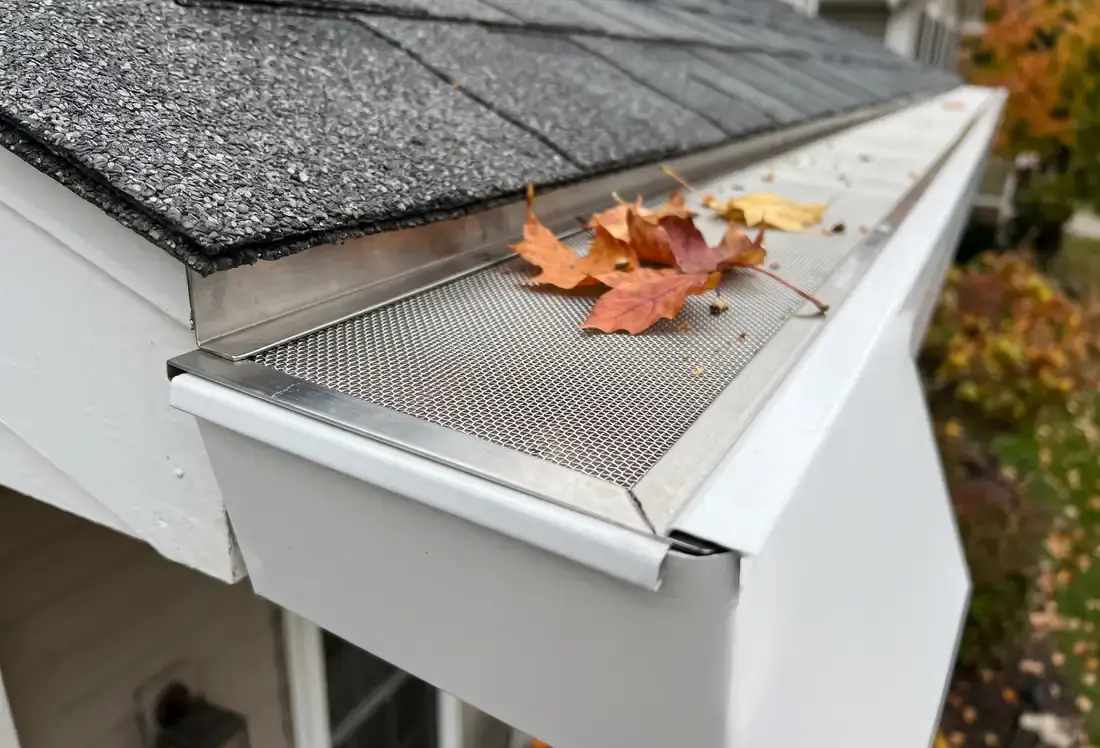
Micro-mesh gutter guards are panels of very fine stainless steel mesh, stretched over an aluminum frame that clips or screws to the gutter. The openings are small enough to stop oak catkins, maple seeds, pine needles and shingle grit, but water passes straight through by surface tension.
In Nashville, where canopy covers roughly 53 to 56 percent of the city and most of it is broadleaf, micro-mesh is the guard most likely to keep outlets clear through both the fall leaf drop and the spring seed and catkin season.
How much do micro-mesh guards cost?
Angi lists micro-mesh materials at about $2 to $4 per linear foot, and its average for installed gutter guards of all types is about $1,514, with most homeowners spending $652 to $2,462. HomeAdvisor puts installed guards at about $6 to $13 per foot. Branded systems sold with lifetime warranties cost more. These are national figures, not quotes.
| Factor | Effect |
|---|---|
| Length of gutter | Priced per foot |
| Storeys and pitch | More time and safety equipment |
| Gutter repairs first | Leaks, sagging and pitch fixed before guards |
| Brand and warranty | Branded systems cost more |
| Valleys and corners | Extra cutting and fitting |
Micro-mesh vs other guards
| Micro-mesh | Screen | Reverse curve | Foam | |
|---|---|---|---|---|
| Stops oak catkins and seeds | Yes | Partly | Partly | Fills up |
| Stops pine needles | Yes | No | Partly | No |
| Heavy rain | Good | Good | Can overshoot | Slows flow |
| Upkeep | Brush surface occasionally | Clear holes | Clean slot | Replace |
| Cost | Higher | Lower | Higher | Lowest |
See screen and reverse-curve guards.
What Nashville trees drop, and how micro-mesh handles it
| Tree | Debris | Micro-mesh result |
|---|---|---|
| Oaks | Leaves, catkins, acorn caps | Leaves blow off; catkins stay on top for brushing |
| Maples | Winged seeds, leaves | Seeds stay out of the trough |
| Sweetgum | Spiky seed balls, leaves | Balls roll off or sit on top |
| Hackberry | Small leaves, berries | Kept out |
| Pines | Needles | Kept out by fine mesh |
Where micro-mesh is most useful
- Under big oaks and maples in Belle Meade, Forest Hills, Green Hills and West Meade.
- On mature streets in Sylvan Park and Inglewood.
- Under pines in parts of Bellevue and Old Hickory.
- On two-storey houses where every cleaning means a tall ladder.
Maintenance
Micro-mesh reduces cleaning but does not end it. Expect to:
- brush or blow debris off the surface once or twice a year, especially after the spring catkin drop;
- check outlets and downspouts annually; and
- look along the mesh after storms for limbs or damage.
Good installation practice
- Fix leaks, sagging and pitch first.
- Attach to the gutter's front lip and back edge so the panel cannot lift in wind.
- Avoid lifting shingles where the roof warranty forbids it.
- Handle valleys with extra outlets or splash guards.
- Flush all downspouts before covering.
An illustration: a two-storey house under a big oak in Green Hills
Picture a two-storey house under a large oak whose catkins fill the gutters every April and whose leaves fill them again in November, needing three cleanings a year. A sensible plan would be to fix any loose hangers, flush the downspouts and fit stainless micro-mesh along the whole run. After that, the owners would expect to brush catkins off the mesh with a soft broom on an extension pole each spring and have the outlets checked once a year, rather than paying for three full cleanings.
Related: are gutter guards worth it, how often to clean gutters.