
On this page
How seamless gutters are made
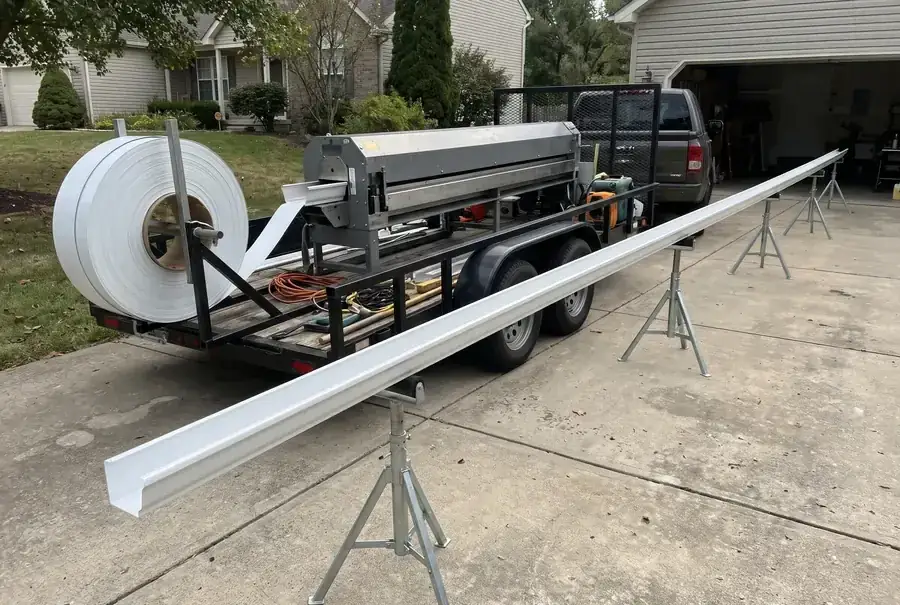
A seamless gutter starts as a roll of flat, factory-painted aluminum coil. The installer feeds it through a forming machine, usually mounted in a trailer or truck at the curb, which bends it into a K-style profile and cuts it to the exact length of the eave. Each straight run is one piece. Joints exist only at the inside and outside miters, the end caps, and the outlets where downspouts attach.
Sectional gutters, by contrast, come in 10-foot lengths from a store and are joined with connectors every 10 feet. A 40-foot eave has three extra seams. Each seam depends on sealant, and sealant is what fails first in long, hot Middle Tennessee summers.
How much do seamless gutters cost in Nashville?
Angi puts seamless aluminum at about $9 to $13 a foot installed. Six-inch costs about 50 cents to $1 a foot more, according to Pro Tool Reviews. These are national figures, not quotes.
| Factor | Effect |
|---|---|
| Total length | Priced per foot; most houses have 120 to 260 feet |
| Gutter size | 6-inch costs more than 5-inch, and needs bigger downspouts |
| Coil thickness | Heavier .032 coil costs more but resists dents better |
| Storeys and pitch | Taller and steeper roofs take more time and safety gear |
| Fascia repair | Rot found when old gutters come off adds carpentry |
| Downspouts and drainage | Extra outlets, longer leaders or buried lines add cost |
Why fewer joints matter in Nashville
Nashville gets about 50.6 inches of precipitation a year, and much of it arrives in heavy bursts. The city's wettest single day on record was 7.25 inches, and 5.75 inches fell on March 27, 2021. In storms like these a gutter is full to the brim, and every seam is under pressure.
Fewer seams mean:
- fewer drips onto brick, siding and windows;
- less water running behind the gutter into the fascia;
- less sealant to maintain over the life of the system; and
- a cleaner look, especially on long runs.
Seamless vs sectional at a glance
| Seamless | Sectional | |
|---|---|---|
| Joints on a 40-foot run | None along the run | Three or four |
| Formed | On site to exact length | Pre-cut 10-foot pieces |
| Typical installer | Gutter contractor | Often DIY |
| Leak risk | Lower | Higher, at each seam |
| Repair | Reseal corners; replace sections | Reseal many joints |
More detail in seamless vs sectional gutters.
What goes with a seamless system
- Hidden hangers screwed into the fascia every 24 inches or so, replacing older spikes and ferrules.
- Factory or hand-cut miters, sealed and riveted at each corner.
- Outlets cut where the downspouts will drain, with more outlets on long runs or near valleys.
- Downspouts in 2x3 or 3x4, with extensions or underground lines.
- Optional gutter guards under oaks and maples.
Where seamless gutters are installed most
Seamless aluminum is the standard choice on almost every house type in the area: post-war brick ranches in Donelson and Inglewood, two-storey subdivision homes in Antioch, Hermitage and Smyrna, and tall infill houses in The Nations and 12South. On historic facades in Belle Meade or Belmont-Hillsboro, half-round or copper may suit the house better.
Seamless gutters and storm damage
One drawback: when a limb or hail damages a seamless run, the damaged length is usually replaced as a whole rather than patched with a short section. Installers can form a new piece on site, so it is rarely a big job, but it is one reason heavier coil and well-placed hangers are worth asking for in a city that has seen the March 2020 tornado, the May 2020 derecho and the January 2026 ice storm.
Questions to ask
- What coil thickness will you use?
- 5-inch or 6-inch for this roof, and why?
- How far apart will the hangers be?
- Where will the outlets and downspouts go?
- Are miters factory-formed or hand-cut, and how are they sealed?
Seamless gutter terms
| Term | Meaning |
|---|---|
| Seamless | One continuous piece per straight run |
| Sectional | 10-foot pieces joined with connectors |
| Hidden hanger | Bracket inside the gutter, screwed to the fascia |
| Pitch | The slope toward the outlet |
| Miter | A formed or cut corner joining two runs |
| End cap | Closes the end of a run |