
On this page
Why Nashville gutters overflow
Nashville rain arrives hard. The city's wettest day on record is 7.25 inches, on May 2, 2010, and 5.75 inches fell on March 27, 2021, the wettest March day on record. Even ordinary spring and summer thunderstorms put more water on a roof in a few minutes than a weak system can carry.
Overflow usually has one of six causes:
| Cause | How to tell | Fix |
|---|---|---|
| Clogged outlet or elbow | Overflow near the downspout; trickle at the bottom | Clear and flush; guards; larger downspout |
| Lost pitch | Water stands in the gutter after rain | Re-hang and repitch |
| Too few outlets | Overflow at the far end of long runs | Add outlets and downspouts |
| Valley overshoot | Water jumps the gutter below a valley | Valley splash guard; outlet near valley |
| Undersized gutter | Clean, pitched gutter still overflows | Upsize to 6-inch |
| Blocked buried line | Backup and spill at the elbow | Flush, snake or replace the line |
How much does it cost to fix overflow?
Angi puts the national average for gutter repair at about $390, with most jobs between $240 and $480. Clearing outlets and repitching is usually at the low end. Adding outlets costs more; upsizing to 6-inch is priced per foot like a new installation, at about $9 to $13 a foot plus 50 cents to $1 for the larger size. These are national figures.
Clogs from Nashville trees
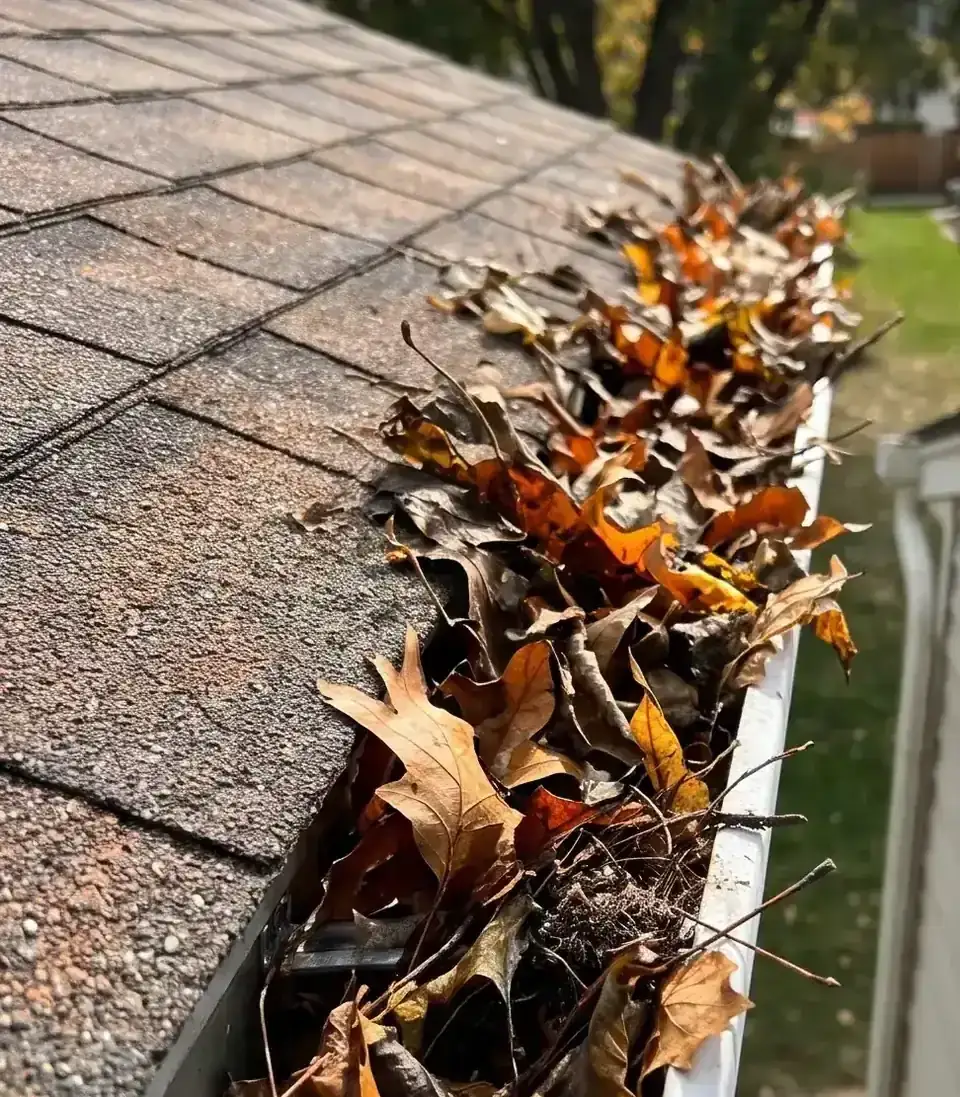
Most overflow starts with a clog. Oak catkins in spring, maple seeds, sweetgum balls and fall leaves collect at outlets and in the first elbow. Under Nashville's heavy canopy, covering about 53 to 56 percent of the city, two cleanings a year may not be enough. See gutter cleaning and gutter guards.
Roof size, pitch and valleys
A steep roof sends water into the gutter fast, and a valley concentrates two roof planes into one spot. Large two-storey homes in Antioch, Mount Juliet, Nolensville and Smyrna, and tall modern infill in The Nations and 12South, often have these roofs. A 5-inch gutter with 2x3 downspouts is frequently too small for them.
Why overflow matters
Overflow water lands right beside the house. On Nashville's clay soils over limestone karst, that can mean:
- a wet crawlspace or basement;
- soil and mulch washing out of beds;
- staining and efflorescence on brick;
- rot in the fascia when water spills over the back; and
- water on walkways and steps.
How a contractor diagnoses overflow
- Run a hose into the gutter at the high end and watch the flow.
- Check that water reaches every outlet and drains completely.
- Look for standing water that shows lost pitch.
- Flush downspouts and buried lines.
- Measure roof planes feeding each run and check valleys.
- Recommend the smallest fix that solves it: clean, repitch, add outlets, or upsize.
Questions to ask
- What is causing the overflow on each side?
- Would more outlets solve it without upsizing?
- Do the valleys need splash guards?
- Is a 6-inch gutter needed on any run?
- Where will the extra water discharge?
An illustration: overflow at a valley in 12South
A tall modern infill house has a valley where the main roof meets a front gable, feeding a short 5-inch gutter over the entry. In every storm, water jumps the gutter and soaks the front steps. The gutters are clean and correctly pitched.
The fix: fit a valley splash guard, add an outlet within a few feet of the valley, and upsize that run to 6-inch with a 3x4 downspout. The rest of the house stays 5-inch. A hose test after the work shows the run clearing without overflow.
Related: 5-inch vs 6-inch gutters, downspout drainage.