
On this page
When 6-inch gutters make sense
Six-inch gutters make sense when a 5-inch gutter overflows even though it is clean and correctly pitched. That usually means the roof plane feeding that gutter is too large, too steep, or has a valley pouring into one short stretch. A 6-inch K-style gutter is only an inch wider at the top, but its cross-section holds noticeably more water, and paired with 3x4 downspouts it drains much faster.
In Nashville the question matters because rain comes hard. May averages about 5 inches, and the March 27, 2021 storm dropped 5.75 inches in one day. Roofs shed that water in minutes.
How much do 6-inch gutters cost in Nashville?
National guides put seamless aluminum at about $9 to $13 a foot installed, with 6-inch usually 50 cents to $1 a foot more. The 3x4 downspouts cost more than 2x3, and you may need extra outlets. These are national ranges; the contractor's quote is the real figure.
5-inch vs 6-inch
| 5-inch K-style | 6-inch K-style | |
|---|---|---|
| Typical downspout | 2x3 | 3x4 |
| Best for | Single-storey, modest roof planes | Large roof planes, steep pitch, valleys |
| Cost | Lower | About 50 cents to $1 more per foot |
| Clogging | Outlets clog more easily | Larger outlets clog less |
| Look | Slim | Slightly larger; in proportion on two storeys |
See 5-inch vs 6-inch gutters for a fuller comparison.
Signs your roof needs 6-inch gutters
- Water overshoots the front of the gutter at a valley.
- Clean gutters still overflow in thunderstorms.
- The roof is steep, roughly 8/12 or more, and water hits the gutter fast.
- A single gutter catches water from a large roof plane, a dormer and a second-storey roof above.
- Downspouts are far apart, and the run between them is long.
Houses that often need 6-inch
| House type | Common in |
|---|---|
| Large two-storey subdivision homes | Antioch, Mount Juliet, Nolensville, Smyrna |
| Tall modern infill with big roof planes | The Nations, 12South, Wedgewood-Houston |
| Large estate homes with steep roofs | Belle Meade, Forest Hills, Oak Hill |
| Houses with complex roofs and valleys | Across the county |
What upsizing involves
Upsizing is not just a wider gutter. A proper job includes:
- Replacing the existing gutter with a 6-inch run formed on site.
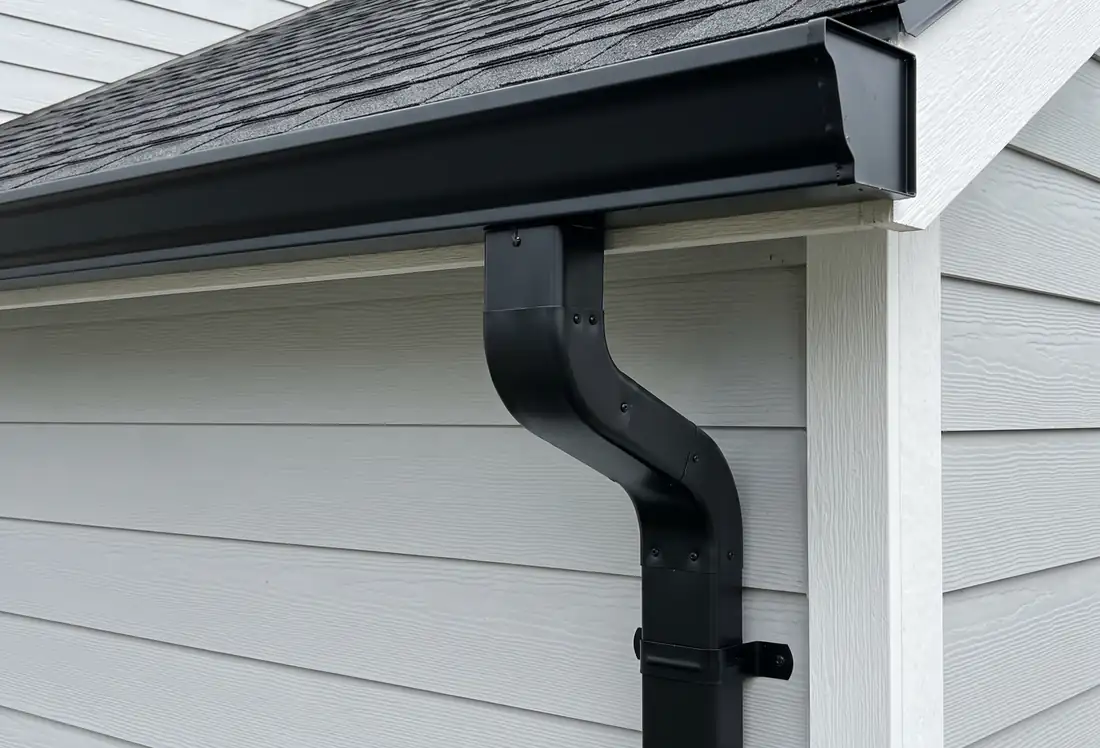
- Larger outlets and 3x4 downspouts.
- Hidden hangers at closer spacing, because a full 6-inch gutter is heavier.
- A check of the fascia and drip edge.
- Extensions or underground lines sized for the extra flow, carrying water well away from the foundation.
The water has to go somewhere
A bigger gutter sends more water to each downspout. On Nashville's clay soils over limestone karst, that water needs to be carried away from the house. Metro Water Services recommends directing downspouts toward lawns and gardens where water can soak in. See downspout drainage and your foundation.
Questions to ask
- Which runs need 6-inch, and which can stay 5-inch?
- Will you upsize the downspouts to 3x4?
- How far apart will the hangers be?
- Where will the extra water discharge?
- Do the valleys need splash guards?
An illustration: a two-storey house in Nolensville
A two-storey subdivision house with a 10/12 main roof, two gables and a valley over the front porch is a classic case. In a hard spring storm, water from the upper roof and the valley lands in the short porch gutter faster than a 5-inch gutter and a single 2x3 downspout can clear it, and it pours over the front edge onto the steps.
A typical fix: upsize the porch run and the long rear run to 6-inch, fit 3x4 downspouts, add an outlet beside the valley, and fit a valley splash guard. The other runs can often stay 5-inch. National guides put the upsizing premium at about 50 cents to $1 a foot.
Related: heavy-rain overflow, seamless gutters.