
On this page
Why gutters sag
A gutter sags when its fastenings can no longer hold its weight. A full 5-inch gutter of wet leaves and water is heavy, and every hanger takes a share of that load.
| Cause | What it looks like |
|---|---|
| Spikes and ferrules loosening | Gutter dips between nail heads; nails backing out |
| Hangers too far apart | Gentle sag between widely spaced brackets |
| Debris weight | Sag where leaves pile up, often near outlets |
| Ice and limb loads | Sudden bends after a storm |
| Soft fascia | Screws pull out; wood crumbles |
| Ladder damage | Kinked front lip where a ladder leaned |
How much does sag repair cost?
Angi puts the national average for gutter repair at about $390, with most jobs between $240 and $480. If the fascia has rotted, carpentry adds to the cost. See fascia and soffit repair.
Why sagging matters
A sagging gutter holds water. Standing water adds more weight, rots the fascia faster, breeds mosquitoes in Nashville's warm months and spills over at the low point, often right beside the foundation. It also pulls the gutter away from the drip edge, so water runs behind it.
Nashville causes
Leaf load. With canopy over roughly 53 to 56 percent of the city, many gutters fill with oak, maple and hackberry leaves every fall. Left through a wet winter, that load loosens hangers.
The January 2026 ice storm. Freezing rain built up half an inch of ice in Nashville and knocked out power to about 232,000 NES customers at the peak. Ice on gutters and limbs falling onto roof edges bent and loosened runs across the county.
Older fastenings. Many 1950s to 1970s gutters in Donelson, Inglewood and Crieve Hall still hang on spikes and ferrules, which loosen as the wood shrinks and swells.
How sagging gutters are fixed
- Empty and clean the run.
- Check the fascia by probing for soft wood. Replace rotten sections.
- Remove old spikes and fill the holes.
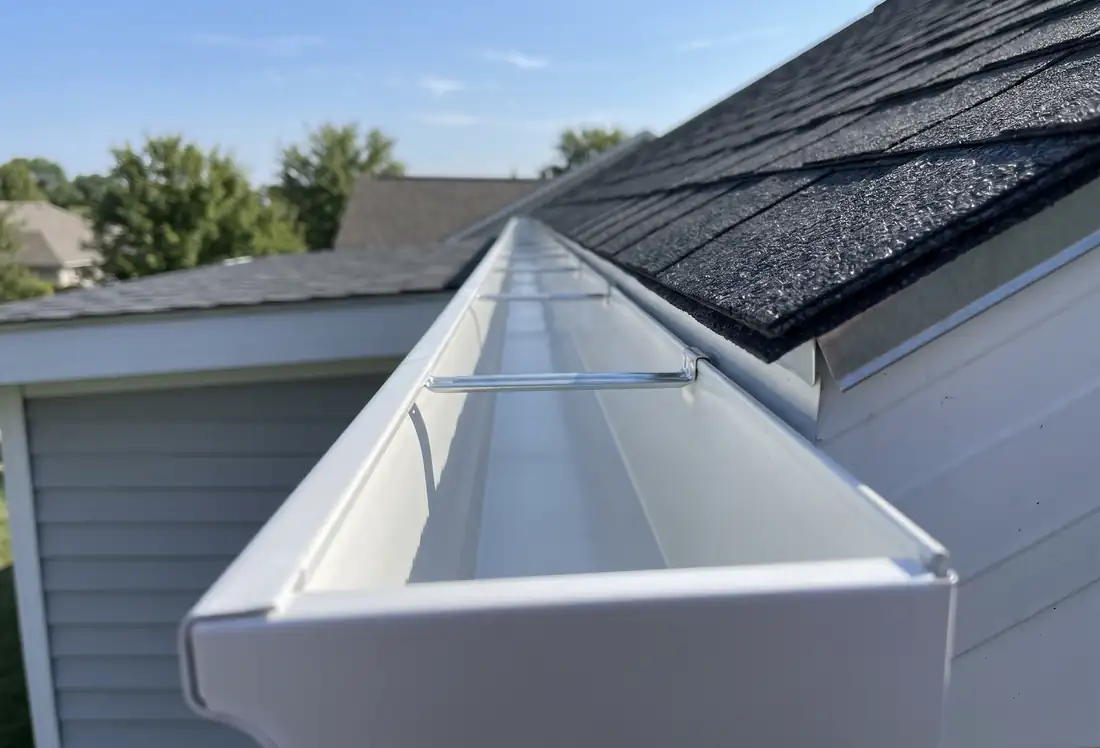
- Install hidden hangers screwed into solid wood, typically every 24 inches and closer under valleys.
- Reset the slope with a level and string line toward the outlets.
- Water test to confirm the run drains completely.
Spikes vs hidden hangers
| Spike and ferrule | Hidden hanger | |
|---|---|---|
| How it holds | Long nail through the gutter into the fascia | Bracket inside the gutter, screwed to fascia |
| Holding power over time | Loosens as wood moves | Screws hold much better |
| Visible | Nail heads on the gutter face | Hidden from view |
| Common on | Older installs | Modern installs |
When to replace instead
If the gutter is bent along much of its length, the metal is thin and kinked, or the whole system is old sectional gutter, replacing with a seamless system may cost little more than re-hanging. See repair or replace gutters.
Questions to ask
- Why is it sagging: fasteners, spacing, weight or wood?
- Is the fascia sound?
- What hangers will you use, and how far apart?
- Will you reset the slope to each outlet?
- Should any sections be replaced?
Sagging gutter terms
| Term | Meaning |
|---|---|
| Spike and ferrule | Long nail through a tube, driven through the gutter into the fascia |
| Hidden hanger | Bracket inside the gutter, screwed into the fascia |
| Pitch | The slope toward the outlet, about a quarter inch per 10 feet |
| Rafter tail | The end of a roof rafter behind the fascia |
| Fascia | The board the gutter fixes to |
An illustration: limb damage after an ice storm
Ice storms like the one in January 2026 bring limbs down on roof edges across wooded areas such as Bellevue and West Meade. A typical result is two or three hangers torn out and a run dipping several inches and holding water, sometimes with a cracked fascia board. The usual repair is to replace the cracked fascia, refit the run on new hidden hangers every 24 inches, reset the slope, and photograph everything for the insurance claim.